.png)

Infusion sets product support
Topics
Watch these how-to videos for instructions on inserting a MiniMedTM Quick-Set infusion set
MiniMedTM Quick-setTM Infusion Set
MiniMedTM Sure-TTM Infusion Set
MiniMedTM MioTM Infusion Set
MiniMedTM MioTM Advance Infusion Set
MiniMedTM SilhouetteTM Infusion Set
MiniMedTM MioTM 30
Key Steps: Infusion set priming / Fill-tubing process
It is important to prevent insulin from accidently getting on top of the reservoir, which could transfer liquid onto the infusion set membrane in the tubing connector. If insulin or any liquid gets inside the tubing connector, it can temporarily block the vents that allow the pump to properly deliver insulin. This may result in the delivery of too little or too much insulin, which could cause hyperglycemia or hypoglycemia.
To help prevent this from occurring, keep these 3 important steps in mind when changing your set:
Always keep the vial upright when removing the reservoir from the tubing connector.
If insulin or any other liquid has gotten on the top of the reservoir or inside the tubing connector, discard both and start over with a new reservoir and infusion set.
If insulin continues to drip or squirt from the infusion set cannula after priming/fill tubing has been completed, do not insert. Start over with a new reservoir and infusion set.
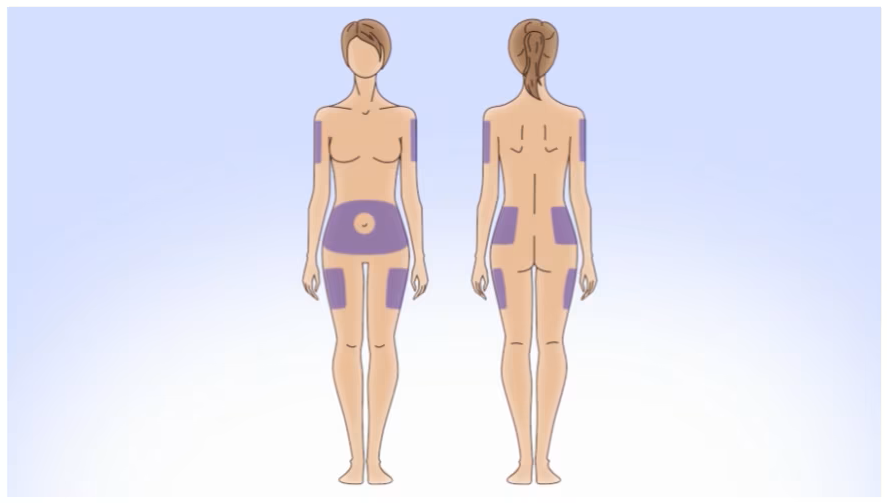
Best body areas for infusion set insertion
Infusion set or tubing issue?
- Disconnect at your site and purge the air bubbles from the tubing using the fill cannula or prime feature.
- Call 24-hour HelpLine at 1 (800) 284-4416, option 1, and 1
Troubleshooting high blood glucose after set change
If you experience a high blood glucose (BG) that does not come down with a correction bolus, follow the tips here. These tips will help you determine if an issue exists with your infusion site, infusion set, pump or your insulin. If you determine your infusion site, infusion set, pump and insulin are OK, continue to follow the protocol for treating a high BG and contact your healthcare professional.
|
Things to examine |
Questions to ask |
Solutions |
|---|---|---|
|
Infusion site problem? |
Is it red, irritated, or painful? |
If yes, change the infusion site, infusion set, reservoir with insulin |
|
Reservoir and infusion set connection issue? |
Are there leaks or breaks? |
If yes, attempt to tighten the connection. If problem persists, change the infusion site, infusion set, and reservoir with insulin. |
|
Infusion set or tubing issue? |
Are there bubbles, larger than champagne bubbles, in the tubing? |
If yes, use your at site disconnect and then purge air bubbles from the tubing using the fill cannula or prime feature |
|
Pump Settings issue? |
|
|
|
Was last meal bolus missed? |
If yes, give correction dose |
|
Are basal rates and times set correctly? |
If not,set basal rates correctly |
|
Is time (AM/PM) set correctly?
|
If not, set time correctly
|
|
Denatured or “bad” insulin? |
Has insulin vial expired or been exposed to high temperatures or direct sunlight? |
If yes, replace with a new vial of insulin and change your infusion set and reservoir with insulin |
|
Insulin pump problem? |
Is pump inoperable? |
Call the 24-hour Technical Support at number 1 (800) 284-4416. |
Information on this site should not be used as a substitute for talking with your doctor. Always talk with your doctor about diagnosis and treatment information.