.png)


Meal DetectionTM technology:
Designed for mealtimes
Published: October 6, 2026 Read time: 4 minutes

Wake up. Fix a high blood sugar. Calculate carbs for breakfast. Deliver a bolus. Check your glucose. Calculate. Deliver. Check. Calculate some more.
Life with diabetes is filled with decisions and mental math — especially around food. Your diabetes technology should help take some of that weight off your shoulders, so you can focus on the people and moments that matter most.
MiniMed automated insulin delivery systems with SmartGuardTM technology offer Meal DetectionTM technology† — a feature designed to provide extra help when carbs are underestimated or a meal bolus is occasionally missed.
What is Meal Detection technology?
Meal Detection technology uses your glucose trends — past and present — to recognize and automatically respond§ to a rapid rise in glucose that can happen after a missed or miscalculated meal dose.†
Here's a real-life example: You're at a game, excited to see your team play. A friend hands you an overpriced hot dog and a drink, which you happily enjoy while rooting for your team.
…and then realize you forgot to bolus.
If your glucose starts rising quickly, like it can after a meal, Meal Detection technology can automatically deliver correction doses as often as every 5 minutes¶ to help bring you back toward your target.
That means extra help in the background, so you can get back to the game without missing a beat.
Why does this matter?
If carb counting feels like one of the hardest parts of managing diabetes, you’re not alone. In fact, 50% of people with diabetes say carb counting is one of the most difficult parts of their daily routine.¹ It’s so challenging that people with type 1 diabetes underestimate carb counts about 63% of the time.²
Imagine planning a party for 20 people – and 33 show up! That kind of surprise can throw everything off.
The same thing can happen when carbs are underestimated. After eating, glucose levels can rise way above your target. Meal Detection technology was built for moments like these. It can recognize that rapid rise and automatically deliver correction insulin as often as every 5 minutes when needed – helping the system respond early and often to bring your glucose back toward target.
See Meal Detection technology in action
In this sample graph, you can see the real results from a person in the pivotal clinical trial:
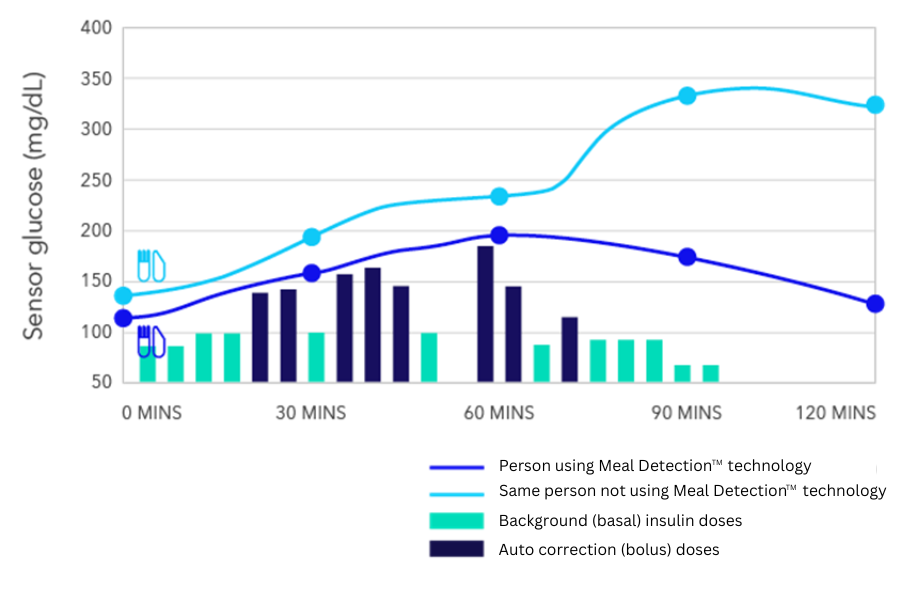
This person:
- Ate a high-carb meal
- Forgot to take a meal dose entirely
Received 8 automatic correction doses from Meal Detection technology
- Stayed within a healthy range
Without Meal Detection technology, the same person went severely out of range within 60 minutes after missing their meal dose. This is one example of how Meal Detection technology can provide extra help when mealtimes don’t go exactly as planned.
Due to inherent study limitations, caution is advised when extrapolating these results to new patients. There could be significant differences.
Not all automated insulin delivery systems respond the same way
Several other insulin pump systems can automatically adjust insulin based on your glucose. But when glucose starts rising after a meal, how they respond can be different.
With Meal Detection technology, MiniMed can automatically deliver a stronger correction bolus when it recognizes a rapid rise in glucose. Then, every 5 minutes, the system checks again to see whether another correction is needed, while also accounting for insulin already working in your body to help protect against lows.
That gives MiniMed more opportunities throughout the hour to respond as your glucose changes.
How is this different from other systems?
Tandem Control-IQ+
Tandem with Control-IQ3 can also deliver automatic correction boluses when glucose is predicted to be high. But Tandem’s AutoBolus is limited to just once per hour and delivers only 60% of the calculated correction.
MiniMed can deliver automatic correction boluses as often as every 5 minutes when needed and can deliver 100% of the calculated correction. So, if your glucose keeps rising after a meal, MiniMed doesn't have to wait up to another hour for the next opportunity to give an automatic correction bolus.
Omnipod® 5
Omnipod 5 can also respond to rising glucose every 5 minutes by increasing its automated insulin delivery through microboluses. But it works differently.
The “microboluses” from OmniPod® provide background insulin delivery every 5 minutes, but corrections from miscalculated doses must be initiated by the user.4
Built for real life — not a perfect one
Carb counting is hard. Sometimes you underestimate the carbs. Sometimes a meal doesn't look anything like you expected. And sometimes you simply forget to bolus.
Meal Detection technology wasn't made for a world where every bolus is perfectly timed and every carb is counted exactly right. It was made for the real world: sporting events, birthday parties, rushed lunches, and distracted dinners.
With the MiniMed FlexTM system or the MiniMedTM 780G system, Meal Detection technology gives you:
🛡️ Forgiveness and extra help for the occasional missed or underestimated carb
🎯 Automatic corrections working quietly behind the scenes as often as every 5 minutes
💪 Less to think about when mealtimes don’t go exactly as planned
You still bolus for meals.† But when carbs aren’t quite right or a meal bolus is occasionally missed, MiniMed can provide extra help by automatically responding to rising glucose.
Because you shouldn't have to get every meal exactly right for your technology to have your back.
Don’t just take our word for it. MiniMed Champion Abby switched from a tubeless pump to MiniMed Flex:


I didn’t realize how much mental energy I was spending on diabetes every day. The biggest difference since using MiniMed is the peace of mind.”
#MiniMedChampion Abby, previous tubeless insulin pump user
Busy workday. Night out. Stadium hot dog at the worst possible moment. We've got you covered.
Footnotes
† Taking a bolus 15–20 minutes before a meal helps to keep blood sugar levels under control after eating.
‡ Refers to SmartGuard™ feature. Individual results may vary.
§ Up to 8% of the total daily dose delivered over 45 minutes.
¶ Refers to auto correct, which provides bolus assistance. Can deliver all correction doses automatically without user interaction, feature can be turned on and off.
References
- Brazeau AS, Mircescu H, Desjardins K, et al. Carbohydrate counting accuracy and blood glucose variability in adults with type 1 diabetes. Diabetes Res Clin Pract. January 2013;99(1):19-23.
- Westen SC, et al. Journal of Pediatric Psychology, 44(1), 2019, 21–31.
- T:slim X2™ with control IQ user guide
- Omnipod® 5 user guide.
Important Safety Information: MiniMed FlexTM system with SmartGuardTM technology with Simplera SyncTM sensor and Instinct sensor
The MiniMed FlexTM system is intended for the continuous delivery of basal insulin at selectable rates, and the administration of insulin boluses at selectable rates for the management of type 1 diabetes mellitus in persons 7 years of age and older, and of type 2 diabetes mellitus in persons 18 years of age and older requiring insulin. The system is also intended to continuously monitor glucose values in the fluid under the skin.
The MiniMed FlexTM system includes SmartGuardTM technology, which can be programmed to automatically adjust insulin delivery based on continuous glucose monitoring (CGM) sensor glucose values and can suspend delivery of insulin when the SG value falls below or is predicted to fall below predefined threshold values. The system is intended for use with connected sensors, including the Simplera SyncTM sensor and integrated continuous glucose monitors, including the Instinct sensor, each of which has different wear-time, form factor, insertion site, and other distinguishing characteristics that relate to sensor performance. Consult the appropriate sensor user guide when using the system. Discuss treatment decisions with your HCP.
WARNING: Do not use the SmartGuardTM feature for people who require less than 8 units or more than 250 units of total daily insulin per day. A total daily dose of at least 8 units, but no more than 250 units, is required to operate in the SmartGuardTM feature.
WARNING: Do not use the MiniMedTM Flex system until appropriate training has been received from a healthcare professional. Training is essential to ensure the safe use of the MiniMedTM Flex system.
WARNING: Do not use SG values to make treatment decisions, including delivering a bolus, while the pump is in Manual Mode. When the SmartGuardTM feature is active and you are no longer in Manual Mode, the pump uses an SG value, when available, to calculate a bolus amount. However, if your symptoms do not match the SG value, use a blood glucose (BG) meter to confirm the SG value. Failure to confirm glucose levels when your symptoms do not match the SG value can result in the infusion of too much or too little insulin, which may cause hypoglycemia or hyperglycemia.
Pump therapy is not recommended for people whose vision or hearing does not allow for the recognition of pump signals, alerts, or alarms. The safety of the MiniMed FlexTM system has not been studied in pregnant women or in persons using other anti-hyperglycemic therapies that do not include insulin. For complete details of the system, including user guides and important safety information such as indications, contraindications, warnings and precautions associated with system and its components, see https://link.minimed.com/Risks.
©2026 Medtronic MiniMed, Inc. MiniMed and MiniMed logo are trademarks of Medtronic MiniMed, Inc. The sensor shape and appearance, Abbott, and “a” logo are marks and/or designs of the Abbott group of companies in various territories and used under license. Sensor image ©2026 Abbott. TM*Third–party brands are trademarks of their respective owners.
Important Safety Information: MiniMedTM 780G system with SmartGuardTM technology with Instinct sensor, Simplera SyncTM sensor, and GuardianTM 4 sensor
The MiniMedTM 780G system is intended for the continuous delivery of basal insulin at selectable rates and the administration of insulin boluses at selectable rates for the management of type 1 diabetes mellitus in persons 7 years of age and older, and of type 2 diabetes mellitus in persons 18 years of age and older requiring insulin. The system is also intended to continuously monitor glucose vales in the fluid under the skin.
The MiniMedTM 780G System includes SmartGuardTM technology, which can be programmed to automatically adjust insulin delivery based on the continuous glucose monitoring (CGM) sensor glucose values and can suspend delivery of insulin when the sensor glucose (SG) value falls below or is predicted to fall below predefined threshold values. The system is intended for use with connected sensors, including the Simplera SyncTM and GuardianTM 4 sensors and integrated continuous glucose monitors, including the Instinct sensor, each of which has different wear-time, form factor, insertion site, and other distinguishing characteristics that relate to sensor performance. Consult the appropriate sensor user guide when using the system. Discuss treatment decisions with your HCP.
WARNING: Do not use the SmartGuardTM feature for people who require less than 8 units or more than 250 units of total daily insulin per day. A total daily dose of at least 8 units, but no more than 250 units, is required to operate in the SmartGuardTM feature.
WARNING: Do not use MiniMedTM 780G system until appropriate training has been received from a healthcare professional. Training is essential to ensure the safe use of MiniMedTM 780G system.
WARNING: Do not use SG values to make treatment decisions, including delivering a bolus, while the pump is in Manual Mode. When the SmartGuardTM feature is active and you are no longer in Manual Mode, the pump uses an SG value, when available, to calculate a bolus amount. However, if your symptoms do not match the SG value, use a blood glucose (BG) meter to confirm the SG value. Failure to confirm glucose levels when your symptoms do not match the SG value can result in the infusion of too much or too little insulin, which may cause hypoglycemia or hyperglycemia.
Pump therapy is not recommended for people whose vision or hearing does not allow for the recognition of pump signals, alerts, or alarms. The safety of the MiniMedTM 780G system has not been studied in pregnant women or in persons using other anti-hyperglycemic therapies that do not include insulin. For complete details of the system, including user guides and important safety information such as indications, contraindications, warnings and precautions associated with system and its components, see https://link.minimed.com/Risks.
©2026 Medtronic MiniMed, Inc. MiniMed and MiniMed logo are trademarks of Medtronic MiniMed, Inc. The sensor shape and appearance, Abbott, and “a” logo are marks and/or designs of the Abbott group of companies in various territories and used under license. Sensor image ©2026 Abbott. TM*Third–party brands are trademarks of their respective owners.
DreaMed Diabetes is a trademark of DreaMed Diabetes, Ltd. The MiniMedTM 780G system algorithm includes technology developed by DreaMed Diabetes.