.png)


From patient to partner: How data changes your diabetes care
Published: September 8, 2026 Read time: 3 minutes
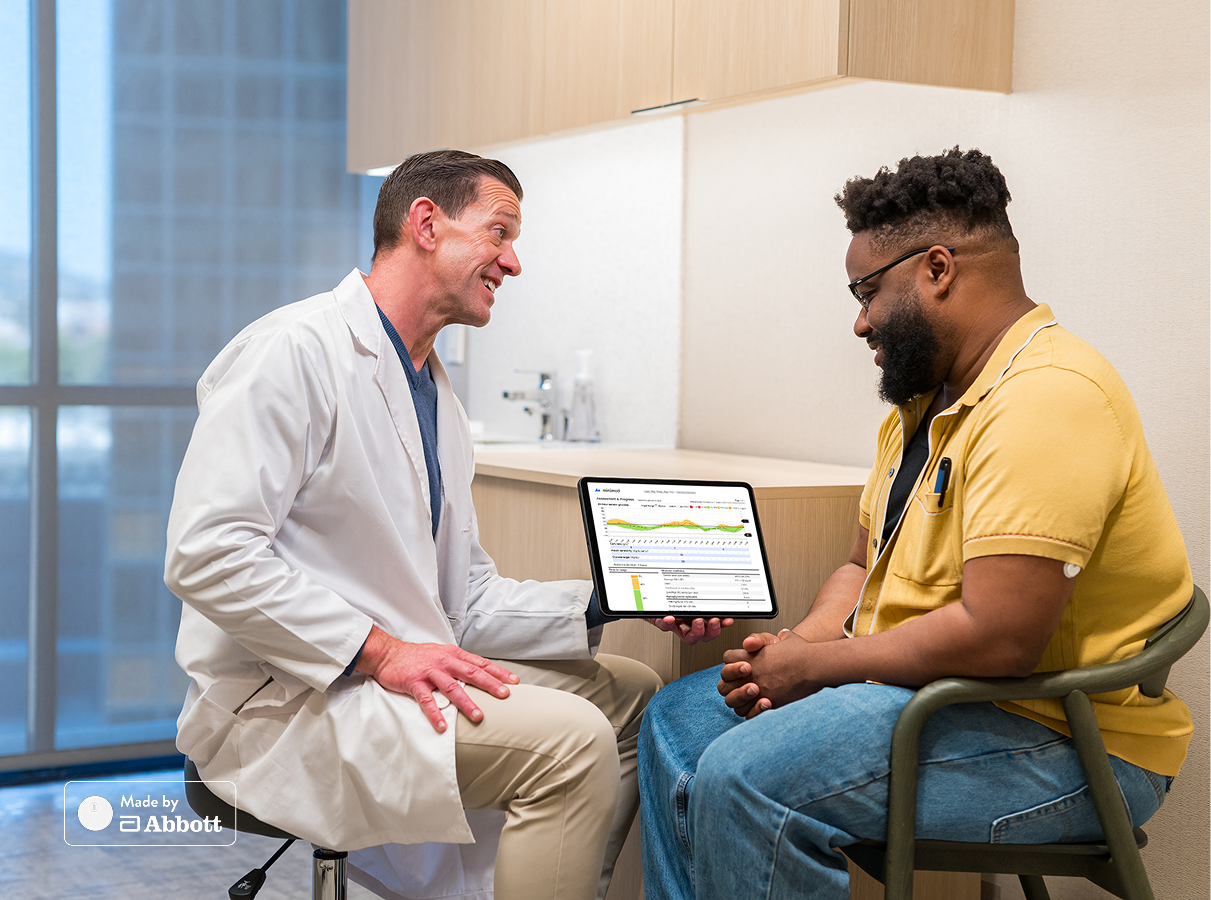
The clinic visit that goes nowhere
Most people with diabetes know this feeling. You took time off work, maybe brought notes, and genuinely hoped to leave with something new. But the appointment wraps up quickly, and you head home with the same plan as before.
This isn't a knock on anyone. Healthcare professionals work hard, and tools like A1C are genuinely useful. But even the best clinicians can only work with the information in front of them — and sometimes, that information doesn't tell the whole story.
The 3-month memory problem
Here's the uncomfortable truth about most diabetes appointments. Your healthcare professional is trying to make treatment decisions about 90 days of your life based on:
• 🩸 A single A1C number
• 💬 Whatever you can remember from the past few weeks
• 📋 Maybe a logbook — if you kept one
The A1C is useful — but it's just an average. It won't show the 3 a.m. lows that woke you up, or the blood sugar spikes every Tuesday after lunch. It smooths everything into one number.
And relying on memory? That's not a personal flaw — it's just how brains work. People are not good at remembering patterns over weeks and months, especially when those patterns feel routine.
So clinic conversations end up sounding like this:
• "Have you had any lows?" — "A few, I think."
• "How's your dosing been?" — "Pretty normal."
• "Any changes in your routine?" — "Not really."
And nothing changes.
The missing piece: Your insulin data
One major thing is still missing from most diabetes appointments: insulin dosing data.
We've made great progress with glucose monitoring. Continuous glucose monitors (CGMs) now track your glucose trends around the clock — showing time in range, overnight patterns, and more. That's a huge deal.
But glucose data alone only tells half the story.
Think of it like reading the results of a science experiment without knowing what was tested. You can see what happened, but you can't figure out why.
Smart insulin pens close that gap. They automatically record every dose — how much insulin, what type, and when — and pair that information with your CGM data. The result? A complete picture of how your glucose and insulin work together.
What a better clinic visit looks like
Let's reimagine that endocrinologist appointment — this time, with the right information on the table.
🔍 Instead of: "Have you had any lows?"
You get: A pattern showing low blood sugar events between 2–4 a.m. after high-carb dinners — pointing to a specific dosing issue that can actually be fixed.
That's not a vague conversation. That's an actionable clinical finding.
📊 Instead of: A single A1C number
You get: A 90-day report showing that your numbers were in the target range 68% of the time. Low glucose numbers happened more often on weekdays, suggesting a possible work schedule connection.
That's not a data point. That's a story with a solution.
💉 Instead of: "How's your dosing been?"
You get: A chart showing that your correction doses after dinner may be too small, and your morning doses may be too large before noon.
That's not a shrug. That gives us clear patterns to focus on.
Same 20-minute appointment. Completely different outcome.
It's not just about data — It's about feeling heard
Living with diabetes is exhausting — not just physically, but mentally. Every day, you make hundreds of small decisions about dosing, food, exercise, and timing. Most of that invisible work goes unnoticed.
When your data tells your story for you — when a doctor looks at the screen and says "I can see how hard you've been working, and here's exactly where we can help" — everything shifts.
Show up as a partner, not just a patient
You already put in the work every day — the MiniMed GoTM system helps make sure your care team can see it.
MiniMed Go is a smart MDI system that connects a CGM with a smart insulin pen, automatically capturing both your glucose data and your insulin doses together in a single app. It's designed to give you — and your doctor — a complete, accurate picture of your diabetes management between visits.
Your diabetes clinic visit doesn't have to end with an unchanged plan and a vague "let's keep an eye on things." When the right data is on the table, conversations get specific. Patterns become visible. Changes become precise. Your data speaks for you.
Ready to change how your appointments feel? Talk to your care team about MiniMed Go — and start showing up to every visit with the full story.
Important safety information: MiniMed Go system
The MiniMed Go system includes the MiniMed Go app, InPen smart insulin pen injector and either the Instinct continuous glucose monitoring (CGM) sensor or Simplera CGM sensor. The system is intended to aid in diabetes management through multiple daily injections of compatible rapid-acting insulins (Humalog, Novolog, or Fiasp). The app and system components each require a prescription. When used with Instinct CGM, the app is indicated for patients ages 7 years and older, or patients ages 2 to 6 years under the supervision of an adult caregiver. When used with Simplera CGM, the app is indicated for patients ages 18 and over. If using InPen alone, the app is intended for all ages, with patients under age 7 requiring supervision. Use of these systems requires, among other things, adequate hearing and vision, a compatible mobile device and operating system, an open app, adequate pairing and connectivity, proper setting, use of an approved rapid-acting insulin, mobile device battery power, proper settings, accurate manual logging of insulin doses administered by means other than InPen, and occasional blood glucose meter (BGM) readings. Establishment of settings and treatment decisions should be made in consultation with a healthcare professional and on the basis of a combination of glucose readings, trend arrows, glucose target, active alerts, and recent events (such as insulin doses, exercise, meals, and medications). Failure to observe these and other details as found in the user guides can result in incorrect dosing, missed alerts and notifications, and ultimately hypoglycemia or hyperglycemia, with serious injury or death possible. For additional safety information and user guides, see https://link.minimed.com/Risks.