.png)


What’s driving your Time in Range? (It’s the algorithm!)

Why does Time in Range matter?
If you're living with diabetes and using an insulin pump, you've probably heard your care team mention Time in Range (TIR). But what does it actually mean for your day-to-day life?
Time in Range is the percentage of time your glucose levels stay within a target range of 70–180 mg/dL.
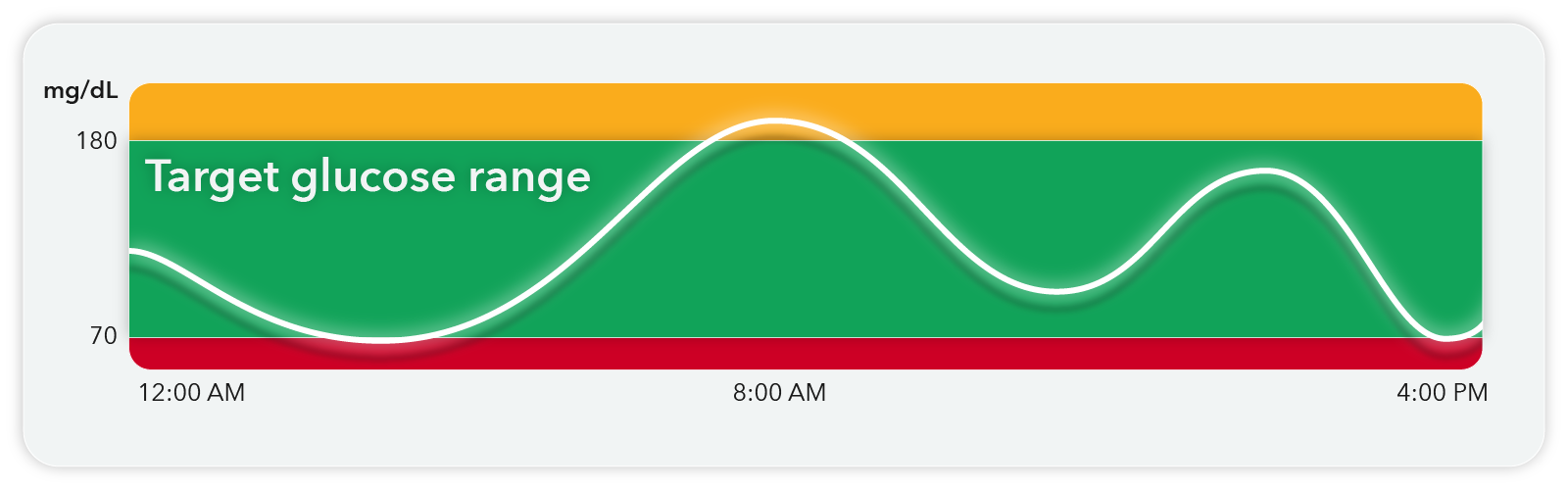
The American Diabetes Association (ADA) recommends spending at least 70% of your time in this range1 — and for good reason. More time in range means less time dealing with the physical and emotional weight of glucose highs and lows. It helps lead to more energy, clearer thinking, and fewer interruptions to the moments that matter most.
Simply put, better Time in Range means better days.
What actually impacts your TIR?
Here's where things get interesting and maybe a little surprising. New clinical data has been published that answered a question that many people living with diabetes have quietly wondered: if I switch sensors, will my outcomes change?
The answer: not much.
The answer, backed by both clinical trial data and real-world evidence from thousands of users, tells us something important about what's really running the show.
What the data showed
A randomized crossover study published† in Diabetes Technology & Therapeutics2 followed MiniMedTM 780G system users who switched between two different sensors: the Simplera SyncTM sensor and the Instinct sensor, made by Abbott.
The results were nearly identical.
No meaningful difference.
No tradeoffs.
Both results far exceeded the ADA's recommended goal of greater than 70% TIR.
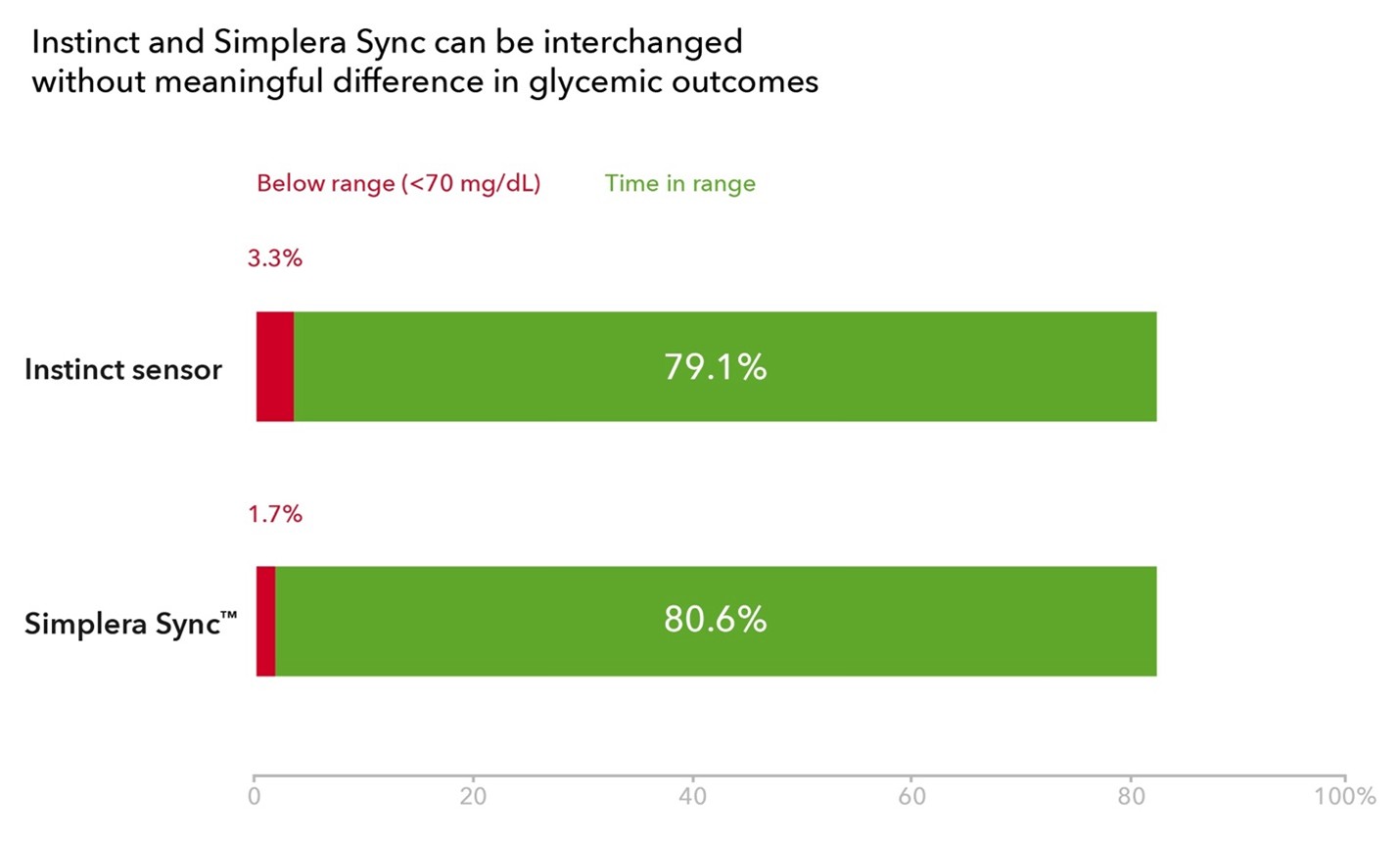
Instinct (N=24), Simplera Sync (N=24)
Real-world† evidence told the same story. An analysis of more than 20,000 MiniMedTM 780G system users in the United States who transitioned from the GuardianTM 4 sensor to the Instinct sensor showed stable results.3 Most importantly, MiniMedTM 780G users spent more time benefiting from automation, some reaching 80.5% among those using recommended settings.
The system matters more than the sensor
Two different sensors.
The same strong outcomes.
What stayed constant across both? SmartGuardTM technology.
Think of it this way: your sensor is the messenger. It reads your glucose levels and delivers that information to the system. But your algorithm is the decision-maker. Every 5 minutes, it's evaluating that data, anticipating where your glucose is headed, and automatically adjusting your insulin delivery to keep you in range.‡
Takeaway
Sensor choice all comes down to just preference. If you ever wondered how changing your sensor would affect your glucose levels, there’s now clinical evidence to tell you that sensor choice doesn’t impact it in any meaningful way if integrated as part of a system with SmartGuardTM technology doing the driving.
What helps drive your Time in Range most is the system algorithm.
At MiniMed, we build every part of our system — the algorithm, the pump, the sensor, and the app — to work together as one. Not because it's a nice idea, but because the data shows it's what drives real outcomes for real people.
Footnotes
† Due to inherent study limitations, caution is advised when attempting to extrapolate these results to new patients. There could be significant differences.
‡ Refers to SmartGuard™ technology. Individual results may vary.
References
1. https://diatribe.org/diabetes-management/time-range
2. Laron-Hirsch, M., et al. Glycemic concordance of Simplera Sync™ and Instinct™ sensors in MiniMed™ 780G system users: A randomized crossover feasibility study. Diabetes Technology and Therapeutics. DOI: 10.1177/15209156261449884.
3. MiniMed data on file: MiniMed 780G data uploaded voluntarily by 20,245 eligible users to CareLink Personal, from 11 October 2023 to 30 April 2026. 8,558 users were using recommended settings (glucose target at 100 mg/dL (5.5 mmol/L) and Active Insulin Time (AIT) at 2 hours).
Important Safety Information: MiniMedTM 780G system with SmartGuardTM technology with Instinct sensor, Simplera SyncTM sensor, and GuardianTM 4 sensor
The MiniMedTM 780G system is intended for the continuous delivery of basal insulin at selectable rates and the administration of insulin boluses at selectable rates for the management of type 1 diabetes mellitus in persons 7 years of age and older, and of type 2 diabetes mellitus in persons 18 years of age and older requiring insulin. The system is also intended to continuously monitor glucose vales in the fluid under the skin.
The MiniMedTM 780G System includes SmartGuardTM technology, which can be programmed to automatically adjust insulin delivery based on the continuous glucose monitoring (CGM) sensor glucose values and can suspend delivery of insulin when the sensor glucose (SG) value falls below or is predicted to fall below predefined threshold values. The system is intended for use with connected sensors, including the Simplera SyncTM and GuardianTM 4 sensors and integrated continuous glucose monitors, including the Instinct sensor, each of which has different wear-time, form factor, insertion site, and other distinguishing characteristics that relate to sensor performance. Consult the appropriate sensor user guide when using the system. Discuss treatment decisions with your HCP.
WARNING: Do not use the SmartGuardTM feature for people who require less than 8 units or more than 250 units of total daily insulin per day. A total daily dose of at least 8 units, but no more than 250 units, is required to operate in the SmartGuardTM feature.
WARNING: Do not use MiniMedTM 780G system until appropriate training has been received from a healthcare professional. Training is essential to ensure the safe use of MiniMedTM 780G system.
WARNING: Do not use SG values to make treatment decisions, including delivering a bolus, while the pump is in Manual Mode. When the SmartGuardTM feature is active and you are no longer in Manual Mode, the pump uses an SG value, when available, to calculate a bolus amount. However, if your symptoms do not match the SG value, use a blood glucose (BG) meter to confirm the SG value. Failure to confirm glucose levels when your symptoms do not match the SG value can result in the infusion of too much or too little insulin, which may cause hypoglycemia or hyperglycemia.
Pump therapy is not recommended for people whose vision or hearing does not allow for the recognition of pump signals, alerts, or alarms. The safety of the MiniMedTM 780G system has not been studied in pregnant women or in persons using other anti-hyperglycemic therapies that do not include insulin. For complete details of the system, including user guides and important safety information such as indications, contraindications, warnings and precautions associated with system and its components, see https://link.minimed.com/Risks.
©2026 Medtronic MiniMed, Inc. MiniMed and MiniMed logo are trademarks of Medtronic MiniMed, Inc. The sensor shape and appearance, Abbott, and “a” logo are marks and/or designs of the Abbott group of companies in various territories and used under license. Sensor image ©2026 Abbott. TM*Third–party brands are trademarks of their respective owners.
DreaMed Diabetes is a trademark of DreaMed Diabetes, Ltd. The MiniMedTM 780G system algorithm includes technology developed by DreaMed Diabetes.